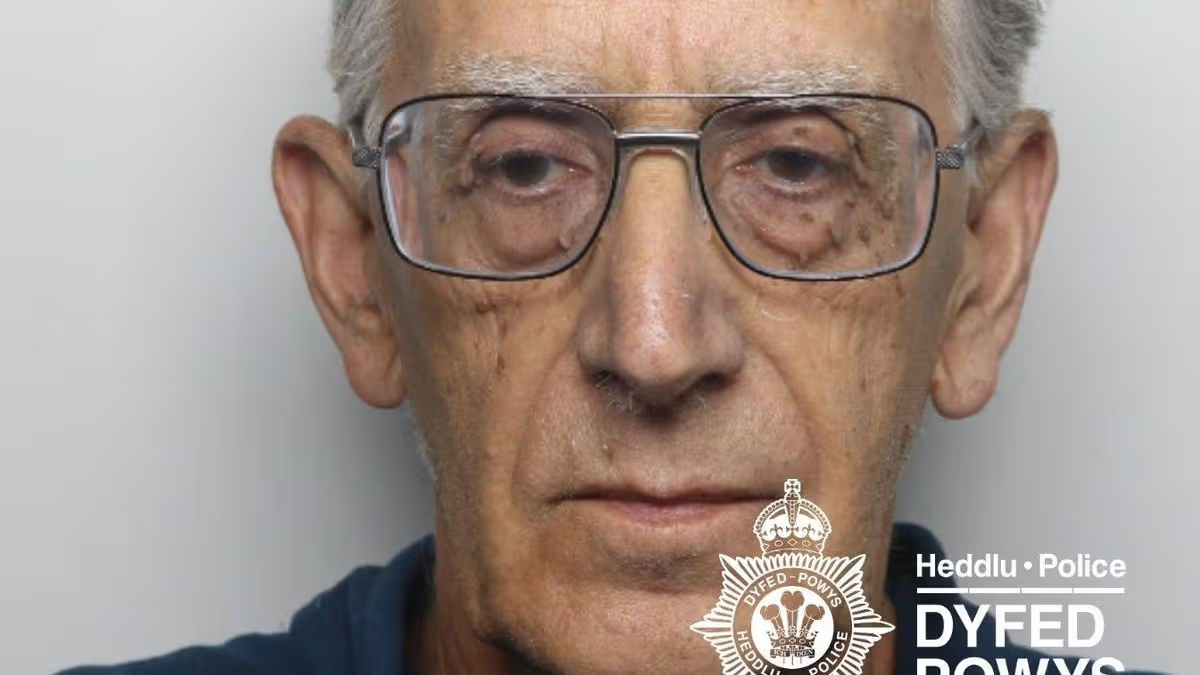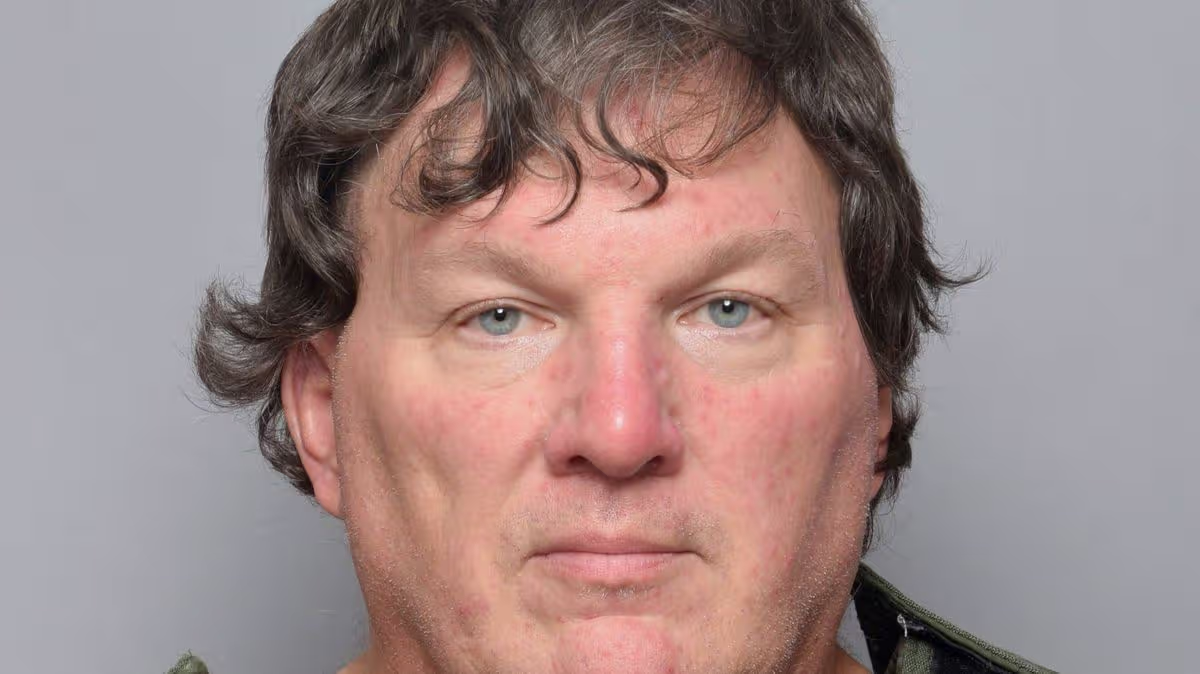
Gilgo Beach serial killer Rex Heuermann, 62, has been jailed for life after murdering eight women between 1993 and 2010

Rex Heuermann, 62, has been sentenced to life without parole(Image: AP)
An architect who murdered eight women in a string of long-unsolved crimes known as the Gilgo Beach killings has been jailed for life without parole.
Rex Heuermann, 62, murdered his victims between 1993 and 2010, with most of their remains found in marshland along the south coast of Long Island, New York, notably at Gilgo Beach.
On Wednesday, Heuermann appeared in court in Riverhead, New York, after pleading guilty in April to the murders of seven women: Megan Waterman, 22, Melissa Barthelemy, 24, Amber Lynn Costello, 27, Maureen Brainard-Barnes, 25, Valerie Mack, 24, Jessica Taylor, 20, and Sandra Costilla, 28.
In April, he also admitted killing an eighth victim, Karen Vergata, who disappeared in 1996 when she was 34 years old. Heuermann had not been charged with her murder.
The investigation into the Gilgo Beach killings began in 2010 after police discovered four sets of human remains along the beach.
Investigators used DNA analysis and other evidence to identify the victims, most of whom were sex workers. The remains of Ms Barthelemy, Ms Brainard-Barnes, Ms Costello and Ms Waterman – known as the Gilgo Four – were found at the beach.
The remains of Ms Taylor and Ms Mack were found along Ocean Parkway, several miles west of Gilgo Beach, while those of Ms Costilla were discovered more than 60 miles away in the Hamptons.
The eighth woman, Ms Vergata, was identified in 2023. Her remains were first found on Fire Island, more than 20 miles west of Gilgo Beach, in 1996, with further remains discovered near Gilgo Beach in 2011.
‘A million years isn’t enough’
Speaking before sentencing, Jasmine Robinson, Ms Taylor’s cousin, told the killer: “You fill me with so much repugnance, I can’t stand it.”
“A million years isn’t enough,” Ms Robinson said. “Nothing will ever make this right.”
Amanda Funderburg, Ms Barthelemy’s sister, urged Heuermann to look at her as she spoke. “I hope you suffer,” she said, recalling a taunting phone call she received from the killer days after her sister disappeared when Funderburg was 15 years old.
JoAnn Mack, the mother of Valerie Mack, said: “Justice has been done, but it can’t replace what has been taken.” She told Heuermann that her daughter “had dreams, and you took them all away from her”.
Liliana Waterman was three years old when her mother, Megan Waterman, vanished. She said she did not fully understand what had happened until she was about nine.
“In an instant, my world was shattered,” she said. “Was she in pain? Was she scared?”
How DNA from pizza crusts linkedHeuermann to the murders
Heuermann has been in custody since he was arrested outside his Manhattan office in July 2023.
In 2022, six weeks after a new police commissioner formed the Gilgo Beach task force, detectives identified Heuermann as a suspect by using a vehicle registration database to link him to a pickup truck that a witness reported seeing when one of the victims disappeared in 2010.
The Long Island architect lived for decades in Massapequa Park, about a 25-minute drive across a causeway spanning South Oyster Bay to Gilgo Beach.
Following the breakthrough, a grand jury authorised more than 300 subpoenas and search warrants, allowing the task force to examine Heuermann’s life in detail. Mobile phone data showed he had been in contact with some victims shortly before they disappeared, investigators said.
Detectives also retested DNA found with the bodies and trawled through Heuermann’s internet search history, which revealed an interest in violent torture pornography, as well as the Gilgo Beach killings and the investigation into them.
To obtain Heuermann’s DNA, a surveillance team followed him in Manhattan, where he worked, and watched as he threw a box of partially eaten pizza crusts into a rubbish bin. Investigators retrieved the box and sent it to a crime lab, which matched DNA from the crusts to a male hair found on burlap used to restrain one of the victims.
After Heuermann’s arrest in 2023, detectives spent more than 12 days searching his backyard and home, where they found a basement vault containing 279 weapons. On his computer, investigators found what they described as a “blueprint” for the killings, including a series of checklists with reminders to limit noise, clean the bodies and destroy evidence.
Last year, a judge rejected Heuermann’s bid to exclude DNA evidence obtained using advanced techniques, which prosecutors said proved he was the killer.