Henry Nowak, 18, died from multiple stab wounds in a brutal attack after a night out. His killer, Vickrum Digwa, falsely claimed he was a victim of a racist attack

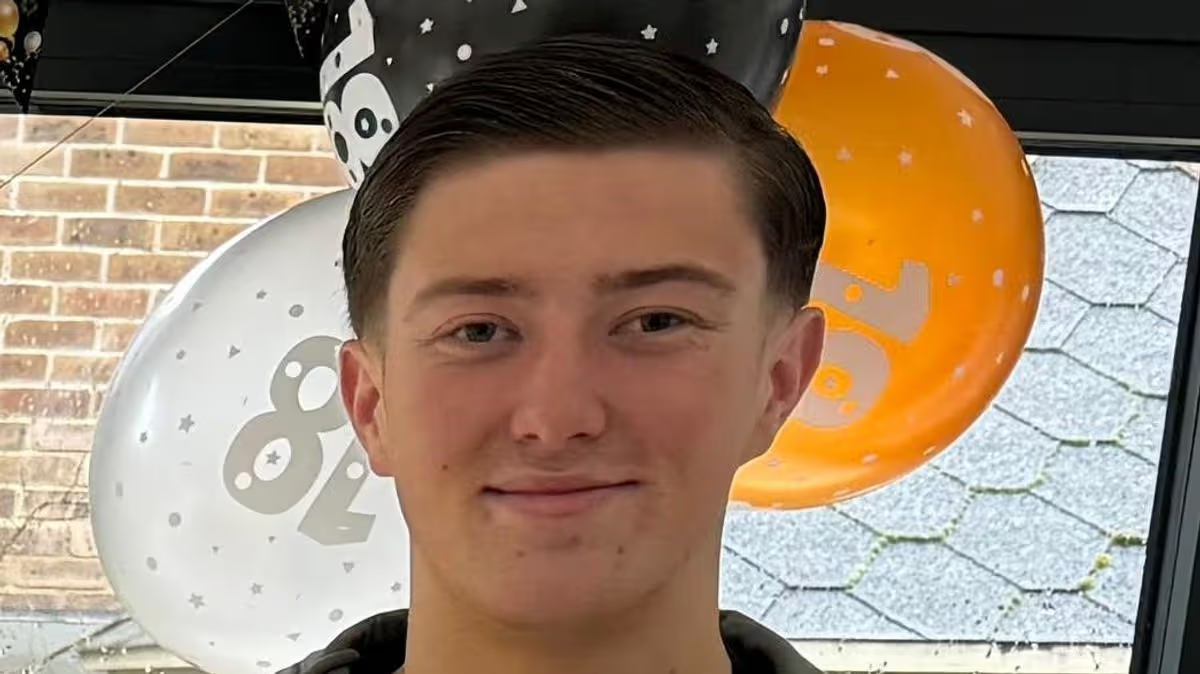
Henry Nowak died after suffering a stab wound to the chest while on a night out with his football team-mates(Image: Family Handout)
A fun night out with friends turned into complete tragedy for 18-year-old Henry Nowak, who was killed in a brutal and random attack.
The university student was sending Snapchat videos to his mates while walking home from an evening out with his football team in Southampton when he was stabbed to death in a chilling chance encounter.
His attacker, Vickrum Digwa, accused Henry of being drunk and racist towards him, leading police to handcuff the teen on the scene as he lay dying. The harrowing reality is that the killer told a “wicked lie”. Today, the killer was jailed for life.
A video of their encounter was found on Henry’s phone, which was recovered from Digwa’s pocket. In the clip, seen by jurors, Henry can be heard saying “Hello car” and singing to himself before yawning, with the video then cutting to show Digwa walking away from him.
Henry, who had drunk less than the drink-drive limit during the evening, is then heard saying: “Innit bad man, what bad man. You’re a bad man, say you’re a bad man, go on.” Digwa replied: “I am a bad man” with Henry then saying “Are you a b…”, before the video cuts off.
Moments later, Henry, from Chafford Hundred, Essex, was attacked with a Sikh knife. “Digwa was carrying an extremely large knife in a sheath openly displayed over his clothing,” Nicholas Lobbenberg KC, prosecuting, told the court. “At half-past midnight that night, Henry was dead, he had been fatally stabbed by Digwa using that knife, the knife that Digwa has chosen to carry out on to the street.”
The weapon was an eight-inch (21cm) shastar blade carried alongside a smaller kirpan. Under Sikh practice, a kirpan is carried in a sheath and must be worn in a holster. Unsheathing it for aggressive reasons violates the Sikh code of conduct.
“The killing wasn’t seen by anyone other than Henry and Digwa, the neighbours heard the aftermath as Henry complained that he had been stabbed and that he was dying, tragically Henry was right on both counts,” Mr Lobbenberg told the court.
“After he had been stabbed, Henry climbed on to a bin and over a fence to try and escape but he had already been fatally wounded and there was a blood trail on the street which demonstrates that he must have been stabbed before he climbed on to the bin and over the fence. Digwa chose to aggressively pursue him.”
A post-mortem found Henry suffered four stab wounds and a cut to his jaw, with two of the wounds to the back of his legs. Analysis of the knife found fatty tissue and blood matched to the victim and hairs from Digwa, as well as DNA from Digwa’s mother Kiran Kaur, 53, who was found guilty of assisting an offender by removing a weapon from the murder scene.
A fatal blow pierced Henry’s heart. As the teen fought for his life, Digwa began constructing what prosecutors would later describe as a “wicked lie”.
Rather than tell officers he had stabbed the student, Digwa claimed he had been racially attacked. He said Henry had punched him and knocked off his turban. Crucially, he did not tell officers his supposed attacker was bleeding from multiple knife wounds. “He didn’t seek help for the man he had injured with his sizeable knife, instead he accused him of being a racist and being drunk,” Mr Lobbenberg told the court.
The teenager’s killer stood nearby as the victim was placed under arrest. Henry then collapsed as the police realised the full extent of his injuries. The first-year student lost consciousness at the scene and never recovered. Despite attempts to administer first aid, he died in the street. “A doctor flew in by helicopter but there was nothing that could be done to save Henry and he was declared dead,” the prosecutor added.
The shocking circumstances only emerged after Digwa stood trial for murder at Winchester Crown Court. Mr Lobbenberg told jurors the defendant had lied repeatedly after the attack, falsely portraying himself as the victim and denying he had stabbed the teen. “Henry Nowak dying alone, humiliated and handcuffed was a direct consequence of Digwa’s dishonesty,” he said.
“Digwa chose on two occasions to make videos, first of Henry fleeing and then of Henry dying with close-ups of his face. The Crown says that is both intrusive and humiliating. His defence describing Henry as a violent drunk racist aggressor compounds the grief of the family.”
Jurors rejected Digwa’s claims that he had acted in self-defence. He insisted he only stabbed Henry after being threatened and grabbed by the hair and claimed he had not realised he had inflicted the fatal chest wound. The jury convicted him of murder and possessing a bladed article in public.
The trial also heard how his mother, Kiran Kaur, arrived at the scene after the stabbing and removed the weapon. The 53-year-old later took the blade back to the family home, where it was eventually recovered by police.
In the UK, it’s legal to possess a kirpan for religious reasons, but there are restrictions that must be obeyed. A blade less than 19in (50cm) is not covered by the Criminal Justice Act 1988 and the Offensive Weapons Act 2019.
Henry’s father Mark Nowak broke down in tears today as he read his victim impact statement to the court in which he described the family’s devastation at the loss of his “beautiful son”.
He said: “As a father, it is my job to protect my child and I failed to keep him safe, I was not there when he needed me most, the thought of him lying in the road, scared, bleeding to death will haunt me forever.”
“I have been traumatised by not knowing exactly what happened that night. A parent losing a child is the worst thing in the world but not knowing how it happened is like a fate worse than hell.”
Describing the impact of Henry’s absence at key family moments, he said: “Completely and utterly devastating doesn’t begin to describe how we are feeling as a family on these significant days and every day in between. I am haunted by all things he will never do.” He added: “As a family, we have all been given a life sentence, this pain will be with me until my dying day.”
The teen’s sister spoke directly to the defendant as she told him: “If you had known him, you would never have hurt him.” She told the court: “My brother was my first best friend, an unbreakable bond, we lived our life to the fullest together. He lit up every room that he walked into and the world became less valuable the day he left.”
She described him as “funny, handsome, precious and kind”, and added: “My brother should not be forever 18, he deserved to grow old and start a family of his own, to be an uncle to my children.”
Meanwhile, Henry’s mother said: “Henry was ambitious, determined and full of life, he was a messy sod and always hungry, but he had his whole life ahead of him, that future has been cruelly taken away.
“The impact of his loss has been devastating not only for me but for our entire family and for all who knew him, we are learning to support one another through this unimaginable grief, but the pain is constant, our family will never be the same.
She also described the moment her son told her, his face “beaming”, that he had been an offered a place to study at the University of Southampton while on holiday in Greece, adding: “It was one of the proudest moments of my life and a moment I will treasure forever.”
Judge William Mousley told the defendant in court today: “Henry Nowak was a much-loved, kind, hard-working and ambitious young man, devoted to his family and with a bright future. He was a first-year student at Southampton University, the first in his family to go to university, he was careful and principled, full of humour, warmth and promise.
“You, Vickrum Digwa, murdered him, by doing so you robbed him of all those he loved, all the things he cared about and liked to do. He would have been expected to live a long and hopefully happy and fulfilling life. You have brought misery and a lifetime of loss upon his family, and great sadness to everyone who knew him.”
He added: “You were sober but were carrying a large Sikh dagger in a sheath attached to a belt over the outside of your clothing. It is a strict requirement of the Sikh faith to have a knife, called a kirpan, at all times. Generally, this will be a small knife, hidden from view, often on a length of cord and worn around the neck. You had that but, in addition, the large dagger in a sheath.”
“You are a member of an order of Sikhs called the Nihang who have a tradition of having a second knife, or kirpan and that is often fully visible, believing that the guru will look favourably on that. You observed that tradition in your everyday life, at work and in public. However, it was not a strict requirement; that is borne out by the fact that neither your brother nor father who arrived on the scene after you had stabbed Henry were so dressed.
“The privilege extended to practising Sikhs of being allowed to be in public with a bladed article and, particularly in respect of the large dagger, a highly dangerous weapon, easily accessible to the wearer, brings with it huge responsibility. It is a fundamental principle of Sikhism that any kirpan is worn as a symbol of religious faith and is never to be carried for an offensive purpose.”
In a statement after Digwa’s conviction, the Sikh Federation said: “Henry’s life has tragically been cut short by a moment of madness by an individual for which there can be no excuses”.
It added: “If a kirpan or a bladed item is used aggressively in an act of violence, the defence under the law for a kirpan does not apply and it is deemed an offensive weapon.
“We understand in this case the weapon that may have been used was not the normal kirpan worn by fully practising Sikhs. This nuance is critically important and may not have been explained or understood by those asked to give evidence in this case.”
The case has been referred to the police watchdog – the Independent Office for Police Conduct – to investigate the officers’ actions. Temporary Deputy Chief Constable Robert France publicly apologised to Henry’s family. “I want to say that I am sorry that Henry couldn’t be saved that night,” he said. “I’m sorry that he was handcuffed and arrested in the moments before he lost consciousness.”