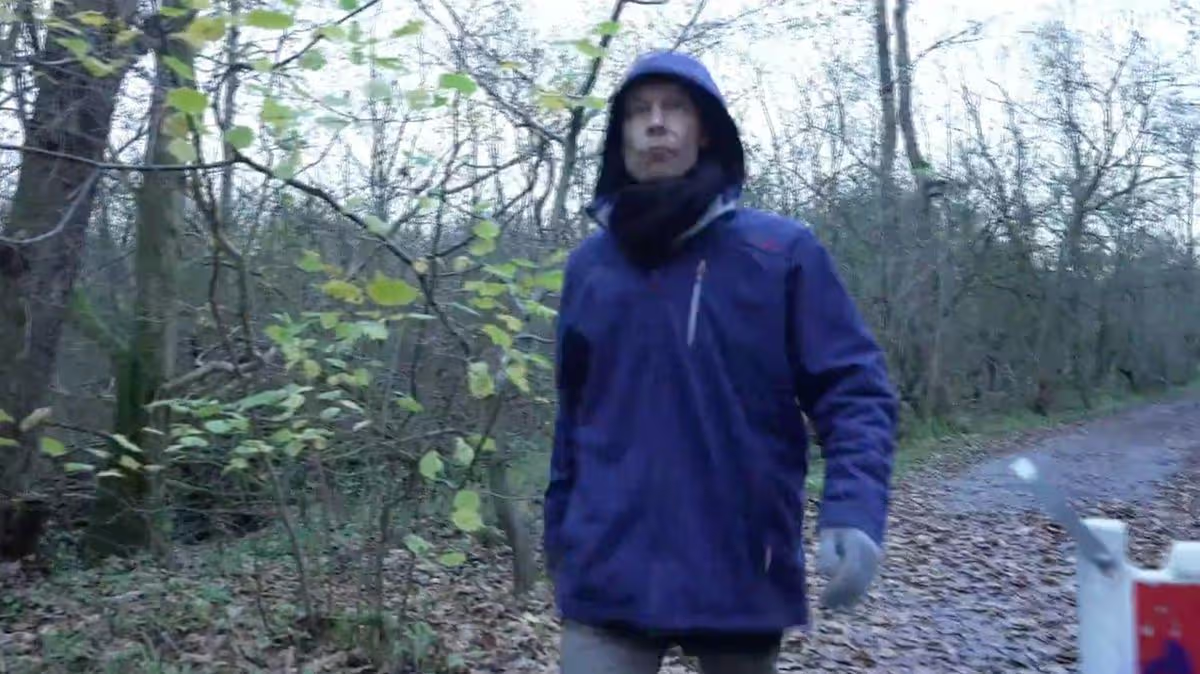
British detectives are said to be pushing for Christian Brueckner to stand trial in the UK over Madeleine McCann’s disappearance – but there’s one huge hurdle
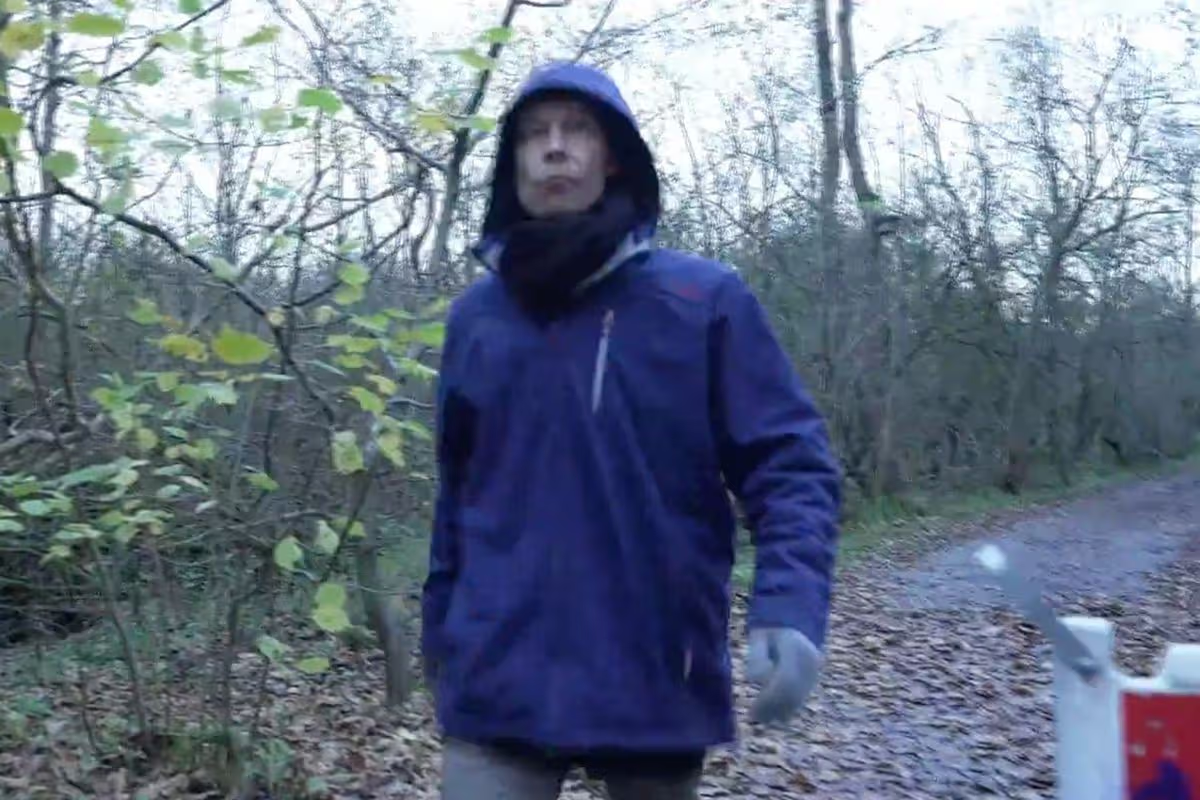
Brueckner was previously discovered living in a makeshift campsite in woodlands(Image: ITV)
Christian Brueckner remains the number one suspect in the disappearance of Madeline McCann, despite never being charged in connection with her abduction. Such is his notoriety, the 49-year-old has been forced to the very fringes of society, chased out of towns by furious locals, and resorting to living in a squalid tent in the woods in an attempt to evade public anger.
Authorities involved in the investigation into Madeleine’s disappearance – in Portugal, Germany, and the UK – remain convinced he is responsible for snatching her. But as it stands, he is a free man, having been released from a German prison in September 2025 after serving a seven-year sentence for the 2005 rape of a 72-year-old American woman in Portugal.
At the time of Brueckner’s release, he was handed strict terms by a regional court at the request of prosecutors, who were concerned that their suspect could flee beyond their jurisdiction. The convicted paedophile was informed that he must wear an electronic ankle monitor for five years as part of his probationary supervision, must contact a probation officer at least once a month, and get court approval of any change of residence, the prosecutor said.
After leaving Sehnde prison, he initially registered himself as homeless in Neumünster and was given sheltered housing by local authorities. But his arrival in the working class town caused major protests from residents on the housing estate – not least because it was home to a number of young families, and had a children’s play area.
His address was subsequently leaked on the internet, and he had to be escorted from the estate by German police officers. At the time, residents said they were afraid of leaving their homes or letting their children play outside. “We were worried that he might hide in one of the cellars,” one told the Telegraph.
In the months that followed, Bruckner drifted between motels in northern Germany before he was found to be living in a makeshift campsite in woodlands near Kiel. Photos of his living situation showed a tarpaulin covering, a bicycle, a dirty sleeping bag, water, and half-eaten jars of food.
Authorities later provided him with a container in the area, but he only remained there for a few days before moving back to his former home town of Branschweig. By March, however, he had been forced to leave the two-room flat he was staying in, reportedly owned by an old friend. He had moved into the property – located near a primary school – just one month prior.
There was a constant police presence around the second-floor property in northern Germany, with two police officers posted behind the building around-the-clock. But Brueckner was nevertheless forced to flee after protests from angry locals.
At the end of April, he moved for at least the fourth time since his release, leaving Branschweig to move further north to the Schleswig-Holstein region.
According to reports, Brueckner has repeatedly tested police officers’ patience – especially when drinking alcohol. During one incident, he is said to have briefly managed to escape officers on a bicycle before dialling the German emergency number and asking them where his escort had gone.
The Mirror has also been told Brueckner, who is living on benefits, boasted of being able to repeatedly sneak out of his bolthole under the cover of darkness without watching police spotting him.
Brueckner’s notoriety means he will likely spend the rest of his life being chased on to new locations. But he is unlikely to ever leave his home country given the recent news that the British police are pushing for Brueckner to be extradited to the UK to stand trial at the Old Bailey.
A top Scotland Yard officer is said to be leading efforts to charge the German suspect on suspicion of abduction and murder ahead of the 20th anniversary of Madeleine’s disappearance next year.
But there’s a major obstacle standing in their way following Brexit; the German constitution prevents the extradition of its citizens to non-EU countries. According to Article 16 of the constitution, German citizens may not be extradited to any foreign countries that are outside of the bloc.
Before Brexit, it would have been much easier to have Brueckner sent over to the UK to stand trial for a suspected crime against a Bruckner decided to leave Germany and made himself vulnerable to arrest. Instead, the Met is said to be determined that he will someday face charges in Germany.
“Because he is a German citizen, Germany is highly unlikely to extradite him to the UK. Under the German Basic Law and the post-Brexit EU–UK Trade and Cooperation Agreement, Germany can refuse to surrender its own nationals, and in practice it does. If there is sufficient evidence, the realistic route is for Germany to prosecute him domestically rather than hand him over,” George Hepburne Scott, a specialist extradition barrister and head of extradition at Church Court Chambers, told the Mirror.
“Pre Brexit the extradition would have been streamlined, fast-tracked and effectively automatic (subject to routine procedural requirements).”
It comes as new details of an investigation into Brueckner emerged this week, which could see him face up to five years in jail. The sex offender and an unnamed man were both arrested on suspicion of “mutual assault” after the altercation in Kiel, northern Germany. Under the country’s law the offence is brought where the suspect is both a perpetrator and a victim.
A source close to Brueckner told the Mirror: “He got attacked by a British person. The guy appeared in front of him together with two other people and a big dog. He yelled at Brueckner and hit him in the face twice and that’s it and then the police came and arrested him. Brueckner called the police. He was injured.”
Contacted by the Mirror on Tuesday, Brueckner, who is living in the Schleswig-Holstein region of Germany, said he was aware of the reports but did not know what would happen next. When asked how he was feeling, he replied: “No comment – I have good lawyers.”