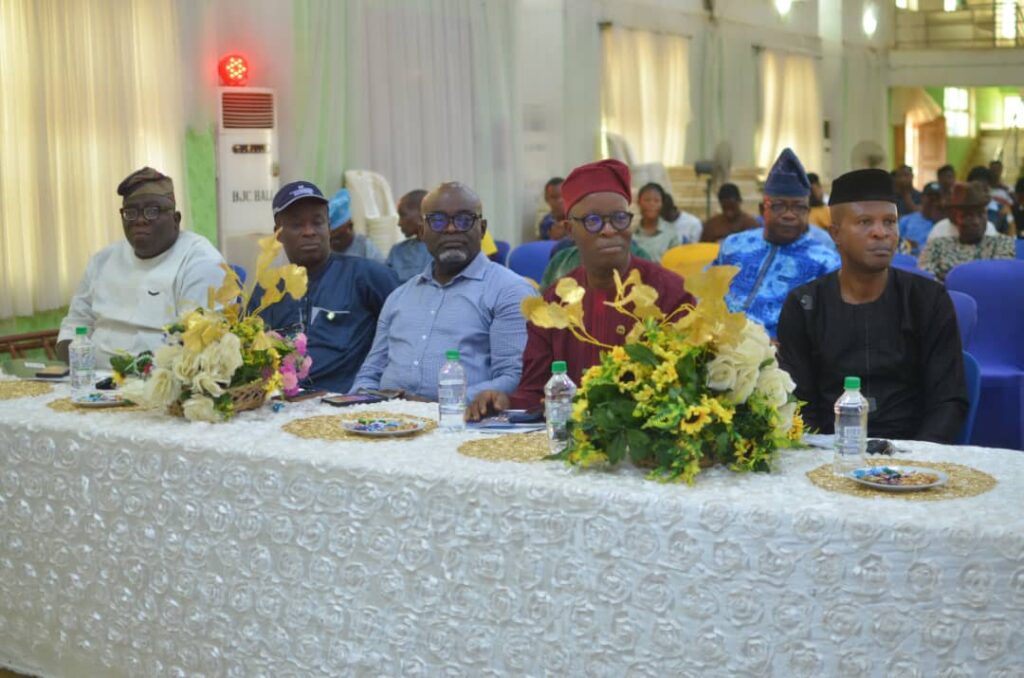
Stakeholders in the built environment and public sector have called for improved access to affordable financing and stronger collaboration among all parties to ensure the success of Public-Private Partnership (PPP) projects in infrastructure development.
This position was reinforced in Ado Ekiti on Saturday during the 2026 Nigerian Institute of Quantity Surveyors (NIQS) Distinguished Guest Lecture, themed “Public-Private Partnership for Sustainable Infrastructure Development: Stakeholders’ Engagement.”
At the event, the Chairman of the NIQS Ekiti State chapter, Olubunmi Ade-Ojo, emphasised that PPP projects are fundamentally designed to serve the public interest, with government and private investors working together to deliver essential infrastructure and services.
She noted that while government provides the framework and oversight, private sector participation is critical in mobilising financial resources needed to execute large-scale projects that may otherwise be difficult to fund through public budgets alone.
Ade-Ojo stressed that the success of PPP arrangements depends heavily on alignment among all stakeholders, including government, private investors and end users of the projects.
She warned that where communities or intended beneficiaries are excluded from the planning and engagement process, projects risk resistance, delay or outright failure despite initial agreements between government and investors.
According to her, meaningful stakeholder engagement helps ensure that projects reflect actual public needs and enjoy broader acceptance, reducing the likelihood of disruptions during implementation.
She also highlighted the importance of public education in helping citizens understand the value of PPP initiatives, particularly in situations where private operators are engaged to provide services traditionally handled by government.
Ade-Ojo added that such understanding enables better decision-making among citizens and helps build trust in alternative financing models used for infrastructure delivery.
She pointed to the presence of officials from various ministries and agencies at the lecture as an opportunity to deepen institutional knowledge of PPP frameworks and improve implementation outcomes.
Also speaking at the event, Ekiti State Head of Service, Folakemi Olomojobi, described bureaucracy as a structured system designed to deliver results, stressing that effective governance depends on coordination and clearly defined processes.
Olomojobi commended successive administrations in Ekiti State for demonstrating political commitment to development partnerships, noting that such commitment has helped strengthen the state’s approach to project delivery and private sector engagement.
She referenced the existence of the state’s Public-Private Partnership Law, first enacted in 2011 and later reviewed in 2020, as evidence of institutional support for collaborative development models.
According to her, the state government recognises its limitations in funding and delivering all infrastructure projects independently and therefore relies on private sector partnerships to meet public needs.
She explained that in sectors such as water supply, healthcare and infrastructure, government and private investors work together to identify community needs and agree on implementation strategies.
Olomojobi said this collaborative approach has contributed to innovations across multiple sectors, including water provision, hospital development and hospitality-related infrastructure in the state.
She added that continuous engagement among stakeholders remains key to sustaining these gains and improving the ease of doing business in Ekiti State.
Delivering a lecture at the event, Dr C.C. Katchy also underscored the importance of affordable financing in PPP arrangements, noting that high interest rates can discourage investment in critical infrastructure projects.
He argued that where governments have access to low-cost funding, such resources should be directed towards productive development projects rather than remaining unused.
Katchy stressed that sustainable PPP models require financing structures that are both accessible and cost-effective to attract long-term private sector participation.
He further emphasised the need for transparency and public awareness in PPP agreements, noting that clear communication helps citizens understand how projects are structured and allows investors to properly assess financial viability.
Across the discussions, a common theme emerged around the need for stronger collaboration, improved financing conditions and greater public engagement as key drivers for successful infrastructure development through PPP frameworks in Ekiti State.