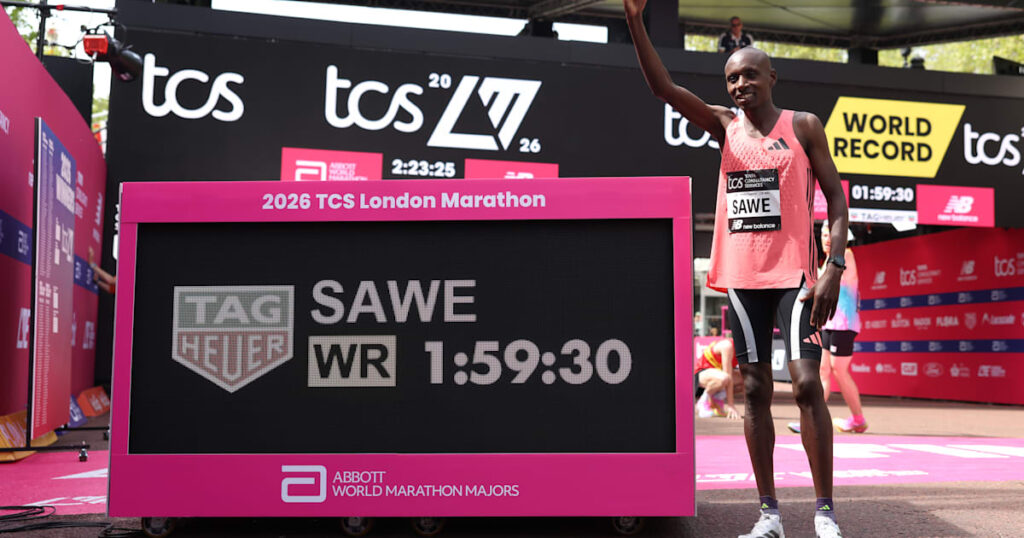
The London Marathon produced a historic double on Sunday as Sabastian Sawe became the first athlete to officially break the two-hour barrier in a sanctioned marathon, while Tigst Assefa set a new women’s-only world record with victory in the elite women’s race.
Sawe, the defending champion from Kenya, delivered a landmark performance by winning the men’s race in 1 hour, 59 minutes and 30 seconds, making him the first runner to go under two hours in official competition under standard marathon rules.
The achievement added a new chapter to distance running history, as previous sub-two-hour efforts had either not been eligible for ratification or had been completed under controlled exhibition conditions.
Ethiopia’s Yomif Kejelcha also ran under the two-hour mark in his marathon debut, finishing second in 1:59:41 after staying with Sawe deep into the closing stages.
Uganda’s Jacob Kiplimo completed the podium in 2:00:28, meaning the top three finishers all bettered the previous official men’s world record of 2:00:35 set in Chicago in 2023 by the late Kelvin Kiptum.
The pace of the race was aggressive from the opening stages, with a lead group of six runners reaching halfway in 1:00:29, signaling that a record attempt was unfolding.
As the race progressed, Sawe and Kejelcha separated themselves from the rest of the field and ran stride for stride into the final kilometres before the Kenyan made his decisive move.
Sawe surged clear in the closing stretch and crossed the line alone to secure both victory and a performance that redefined the limits of official marathon racing.
After the race, he said he had prepared specifically for a major run in London and felt strong in the latter stages. He said seeing the finishing time brought excitement after months of focused preparation.
The result inevitably drew comparisons with Eliud Kipchoge’s famous 1:59:40 run in Vienna in October 2019, when the Kenyan became the first person to cover marathon distance in under two hours.
However, Kipchoge’s time was not recognised as a world record because it took place in a specially staged event that used rotating pacemakers, customised race conditions and arrangements outside standard competition regulations.
Sawe’s performance, by contrast, came in open competition and therefore carries official historical significance.
The Kenyan also wore Adidas’s newly released Pro Evo 3 racing shoe, a lightweight supershoe reported to weigh under 100 grams, highlighting the continued role of technology in modern endurance performance.
In the women’s elite race, Tigst Assefa of Ethiopia delivered another dominant display by winning in 2:15:41, setting a new women’s-only world record and breaking the previous mark she established on the same course last year.
Assefa was engaged in a closely contested battle for much of the race with Kenyan stars Hellen Obiri and Joyciline Jepkosgei before pulling away in the final stages.
Her winning time lowered her own previous women’s-only best by nine seconds, reinforcing London as one of the fastest major marathon courses for elite women.
Speaking after the race, Assefa said she was delighted to defend her title and especially pleased to achieve one of her key goals of breaking her own record.
Kenya’s Hellen Obiri finished second in a personal best time of 2:15:53, continuing her successful transition from track to road racing after a decorated career over 5,000 metres.
Joyciline Jepkosgei was third, crossing the line only fractions of a second behind Obiri in one of the closest finishes in recent London Marathon history.
While Assefa now owns the women’s-only record, the absolute women’s world record remains with Kenya’s Ruth Chepngetich, who ran 2:09:56 in Chicago in October 2024 in a mixed race format where elite women benefit from male pacemakers.
The distinction between mixed-race and women’s-only records has become increasingly important in marathon statistics, as pacing conditions can significantly influence finishing times.
Beyond the elite races, the event also highlighted the growing mass appeal of marathon running.
Organisers expected more than 59,000 participants to complete the 26.2-mile course through the streets of London in warm spring conditions.
Last year’s race set a world record for marathon finishers, with 56,640 runners completing the distance.
Officials have since said they are considering expanding the event to two days next year, which could allow as many as 100,000 runners to take part.
The London Marathon has also become one of the world’s most powerful charity fundraising events. The 2025 edition raised a record £87.3 million, equivalent to about $118 million, setting a new benchmark for the largest one-day annual fundraising event.
Sunday’s race therefore combined elite sporting history with mass participation and charitable impact, further strengthening the London Marathon’s status as one of the premier events on the global athletics calendar.