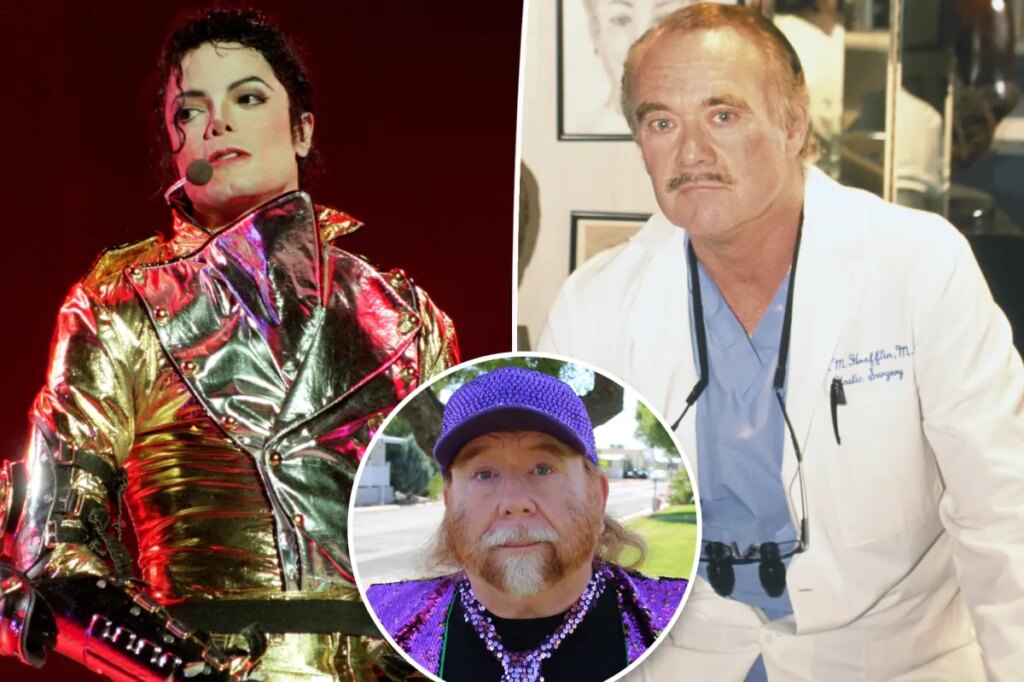

Michael Jackson could still have been alive today had it not been for the “selfish” approach of his close pal and “dermatologist to the stars” doctor, Arnold Klein, according to Geoffrey Mark.
Mark alleges that the doctor acted more like an enabler than a responsible medical professional.
“Arnie thought that Michael was addicted, but that didn’t stop him from writing the prescriptions,” Mark said of Klein, who first introduced him to the superstar.
In the last few months of Jackson’s life, Klein (who died in 2015) jabbed the singer dozens of times with Demerol and gave him Botox treatments at his Beverly Hills office.
Mark believes that Klein “didn’t try hard enough” to wean Jackson off substances or intervene, despite those who knew the singer having tough talks about him.
Instead, Mark claims that Klein was more focused on enriching his own wealth and status than aiding in his friend’s recovery.
“To that end, Arnie couldn’t say ‘no’ to Michael,” he added, “because saying ‘no’ to Michael would have ended that kind of entrée.”
Mark further claimed that Klein’s self-centered mindset also impacted Jackson’s care.
“His nature was having financial, social power and getting himself the spotlight, getting the men he wanted to be with, getting famous people to want him and need him, so that he was on the inside of things,” the author alleged. “And then once he was on the inside, he used what he learned to further himself.”
Despite morally bankrupt Klein “enabling him for so long,” Mark believes that Jackson still played the ultimate role in his own death.
“Michael had millions of dollars to go to other doctors who would have just as happily taken the money and enabled him,” Mark explained. “So unfortunately … the addiction was already there, and no one person could have made a difference, except Michael himself.”
“An addict needs a moment of clarity,” Mark added, “to understand, ‘If I don’t change, I’m gonna die.’”
Jackson died at the age of 50 on June 25, 2009, from cardiac arrest caused by acute propofol and benzodiazepine intoxication. The fatal dose was administered by the “Man in the Mirror” singer’s physician, Dr. Conrad Murray, who was trying to treat the pop icon’s insomnia.
Murray was convicted of involuntary manslaughter and served less than two years in prison before his release in October 2013.
As Mark noted, Jackson used a staggering amount of meds and narcotics in the last 20 years of his life, including cocaine, daily Demerol jabs while on tour and hospital anesthesia Diprivan to aid in his sleep.
The “Thriller” singer also allegedly used sedatives, including Lorazepam, Midazolam and Diazepam, and stronger meds like Xanax, Zoloft, hydrocodone, paroxetine, carisoprodol, and hydromorphone regularly.
Mark further claimed that Jackson became hooked on meds after suffering scalp burns following a pyrotechnic accident on the set of a 1984 Pepsi advert.
Despite his concerns, he felt powerless to stage any kind of intervention with the singer at the time.
“An ethical doctor or a good psychologist could have helped him,” Mark alleged.
“In the bigger picture of addiction, I’ve tried to help a lot of celebrities through the years. I’ve had more failures than successes, quite frankly. When I realized there was nothing I could say or do for Michael or Arnold that could be helpful, I walked away.”