A resident of Ogun State, Mr. Adejare Olasunkanmi, has accused a police prosecutor, ASP Matthew Famuyiwa, of receiving a bribe and removing 18 vital exhibits from a criminal case file at the Magistrate’s Court in Isabo, Abeokuta, Ogun State, to frustrate the prosecution of suspects standing trial over an alleged violent attack against him.
Olasunkanmi told SaharaReporters that Famuyiwa allegedly conspired with the defence counsel representing the defendants to undermine the criminal proceedings through the disappearance of critical evidence in his case file.
“Famuyiwa prosecuted a case on my behalf at Magistrate’s Court, Isabo, Abeokuta, Ogun State, but he collected a bribe from the defendants and their lawyer and removed all the vital 18 exhibits from the case file,” he told SaharaReporters.
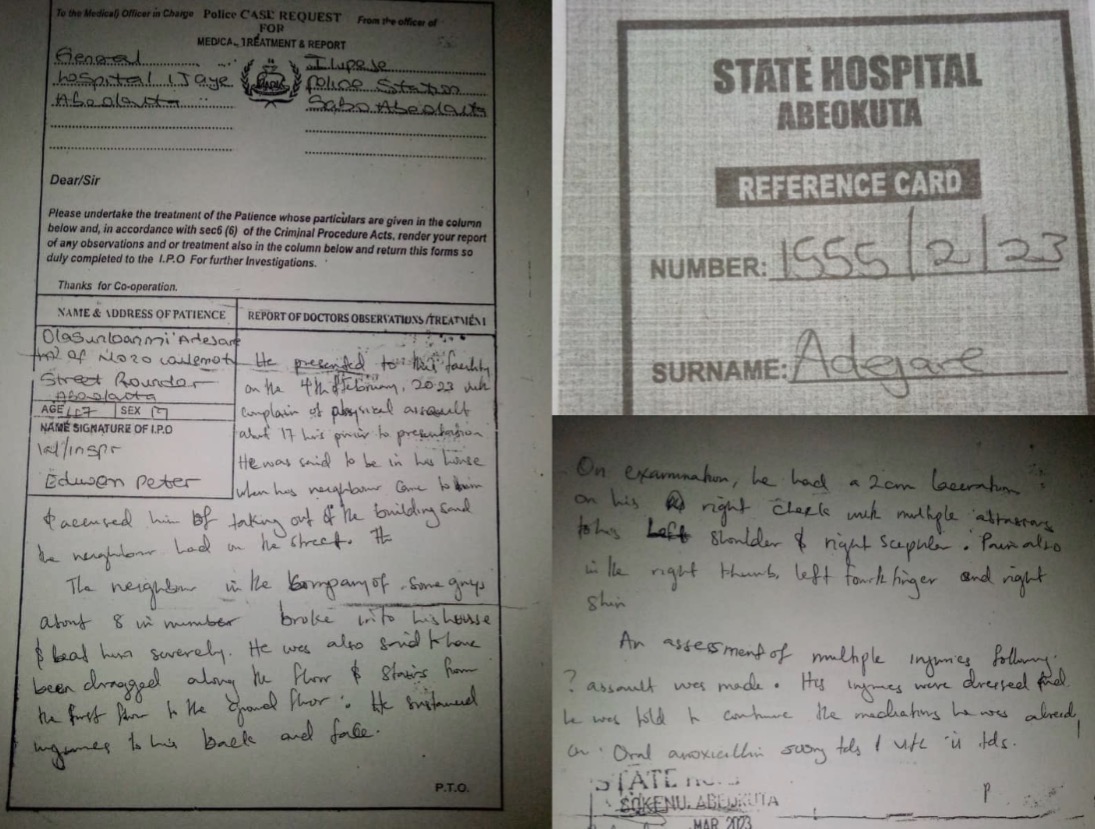
Olasunkanmi alleged that the missing exhibits Famuyiwa allegedly removed from his case file include eight crime scene photographs, including “Some of the pictures where I was soaked with my blood, medical report issued to me by the General Hospital, Ijaiye, Abeokuta, patient card issued to me on admission at the General Hospital, Ijaiye, Abeokuta.”
“Patient card issued to me at Abraham Hospital, a private hospital I was taken to by the Police for first aid treatment on the night of the violent attack, receipt issued to me by Abraham Hospital after treatment, receipts of the medicine I purchased during and after treatment.
“One of the photographs where I was dragged on the ground by my attackers, showing my back filled with injuries, lacerations and bruises, pictures from the crime scene with remnants of the bottles that were used to attack me, taken by the IPO Inspector Blessing Eduwem Peters, another photograph taken by the IPO while I was inside the Police station.
“Some of the weapons that were used to attack me, which were recovered at the crime scene by the IPO, my first bank account statement of N50,000 that the criminals who violently attacked me paid into my account as an admission of guilt, another of my first bank account statement of N50,000 that I refused to accept from them through the prosecutor after they were arraigned in court.”
Olasunkanmi also accused the Ogun State Police Command of refusing to investigate an earlier complaint he submitted against the prosecutor despite directives from the office of the Assistant Inspector-General of Police (AIG) in charge of Zone 2 Command, Lagos.
According to him, he had initially written to the AIG on January 2, 2025, alleging criminal conspiracy, criminal breach of trust, betrayal of public trust, professional misconduct and unprofessional conduct against Famuyiwa.
He told SaharaReporters that the petition was acknowledged on January 14, 2025, and that he was later informed by ASP Ademola Joseph that the petition had been forwarded to the Commissioner of Police in Ogun State, who subsequently referred it to a Deputy Commissioner of Police for investigation.
However, Olasunkanmi alleged that no investigation was ever conducted, saying, “The refusal of the Ogun State Command to investigate my petition against Prosecutor Matthew Famuyiwa prompted me to write this fresh petition,” he stated.
He said that the Investigating Police Officer (IPO), Inspector Blessing Eduwem Peter, in the original criminal case file, documented the crime scene by taking photographs after the alleged attack on February 3, 2023.
Olasunkanmi said the officer also accompanied him to the General Hospital, Ijaye, Abeokuta, where medical reports and other relevant documents were obtained and included in the case file before the suspects were arraigned.
He claimed that the disappearance of the documents significantly weakened the prosecution’s case.
Olasunkanmi further alleged that before the trial was concluded, the defence counsel, whom he identified as Augustine Ihunba, repeatedly attempted to persuade him to settle the matter out of court through financial compensation.
According to him, he rejected the offers, alleging that the prosecutor instead accepted financial inducement to compromise the prosecution.
Olasunkanmi cited the judgment delivered on December 20, 2024, by Chief Magistrate A.K. Araba, arguing that it stated that no photographs or medical documents were tendered before the court.
He contended that the judgment corroborated his allegation that the exhibits had been removed from the case file before trial.
Olasunkanmi also told SaharaReporters that he petitioned the Chief Judge of Ogun State over the conduct of the police prosecutor but was advised to forward the complaint to the appropriate police authorities.
He added that his previous experience working as a litigation officer in the chambers of human rights lawyer Femi Falana (SAN) had taught him the importance of preserving documentary evidence in criminal proceedings.
Olasunkanmi called on the Assistant Inspector-General of Police, Zone 2 Police Command, to order a thorough investigation into the allegations against Famuyiwa and prosecute him for alleged criminal conspiracy, criminal breach of trust, betrayal of public trust, and violations of police ethics and professional conduct.
According to a certified true copy of the judgment delivered on December 20, 2024, by Chief Magistrate A.K. Araba in Charge No. MA/153C/2023, obtained by SaharaReporters, the court reviewed the evidence presented during the trial involving defendants Alani Adepo, Sherrif Adejare, and Adepo Quadri.
According to the judgment, the prosecution called two witnesses: the investigating police officer, Inspector Blessing Eduwem Peter, and the complainant, Adejare Olasunkanmi.
The investigating officer testified that she visited the crime scene after the alleged assault, obtained statements from the parties, and tendered several documentary exhibits, including the defendants’ statements and a bank transfer receipt relating to an attempted settlement.
The complainant testified that he was allegedly attacked by the defendants and several others after being accused of stealing sand.
He told the court that he sustained head and eye injuries after being struck with a shovel and a bottle, while his residence was allegedly looted during the assault.
Olasunkanmi claimed his cash, mobile phones, and other valuables were stolen, adding that the investigating officer photographed his injuries at the police station before referring him for medical treatment.
The defendants, however, denied the allegations, insisting the dispute stemmed from a disagreement over sand allegedly taken by the complainant.
They maintained that no assault, theft or damage occurred and told the court they agreed to pay N50,000 in an attempt to settle the matter out of court.
The defendants denied participating in the alleged assault, theft, or destruction of Olasunkanmi’s property.
Under cross-examination, one of the defendants, Quadri, told the court that he merely cautioned Olasunkanmi during a disagreement over sand and denied conspiring with anyone to attack him or steal his money, insisting that he was at home on the day of the incident.
In her judgment, Chief Magistrate Araba held that the central issue before the court was whether the prosecution had proved the defendants’ guilt beyond reasonable doubt, as required under Nigerian law.
Citing several Supreme Court authorities, the magistrate reiterated that the burden of proof in criminal proceedings rests entirely on the prosecution and never shifts to the accused persons.
Although Olasunkanmi alleged that N255,000 was stolen from his apartment after the alleged assault, the court noted that his initial statement to the police did not state that he actually saw any of the defendants enter his room or take the money.
The investigating police officer also testified that none of the allegedly stolen items or cash were recovered during the investigation.
The magistrate concluded that the allegation of theft was speculative and amounted to an afterthought, holding that the prosecution failed to establish the offence beyond reasonable doubt.
On the allegation of unlawful assault, the court found that although Olasunkanmi claimed he sustained serious injuries and was photographed by the IPO before receiving medical treatment, neither the alleged medical report, the police medical form, nor the photographs were tendered in evidence.
The court also held that Olasunkanmi did not present any visible injuries during the trial to support his claims.
Consequently, the court ruled that the prosecution failed to establish the essential ingredients of assault.
Similarly, the court dismissed the charge of unlawful damage, noting that Olasunkanmi failed to tender the allegedly damaged mobile phones and power bank as exhibits.
The court held that there was no credible evidence linking the defendants to the alleged destruction of the property.
On the conspiracy charge, the court held that the prosecution failed to prove any agreement among the defendants to commit an unlawful act.
The court held that there was no direct or circumstantial evidence establishing a conspiracy, adding that one of the defendants was not even present at the scene, according to the evidence before the court.
Chief Magistrate Araba held that the prosecution failed to prove all four counts beyond reasonable doubt and accordingly discharged and acquitted the three defendants.
Olasunkanmi Insists On His Allegations Against Police Prosecutor
However, Olasunkanmi relied on the same judgment to support his allegations, noting that the court’s repeated references to the absence of photographs, medical reports, and other documentary evidence corroborated his allegation that 18 crucial exhibits had been unlawfully removed from the case file by the police prosecutor before the conclusion of the trial.
He maintained that photographs, medical records, hospital documents, and other exhibits collected during the police investigation were removed before they could be presented in court.
Olasunkanmi urged the Assistant Inspector-General of Police in charge of Zone 2 Command, Lagos to investigate the alleged disappearance of the exhibits and determine whether any criminal misconduct or professional negligence occurred during the prosecution of the case.